Diffuse Nebulae
Horsehead NebulaThe darker, horsehead-shaped dust cloud (known as Barnard 33) is in front of a larger, luminous nebula (called IC 434). |
 |
 |
IC 405The Flaming Star Nebula |
|
IC 5146The Cocoon Nebula |
 |
 |
M8The Lagoon Nebula |
|
M16The Eagle Nebula |
 |
 |
M20The Trifid Nebula |
|
M24Sagittarius Star Cloud |
 |
 |
M42The Orion Nebula is one of the most beautiful diffuse nebulae in the sky. |
|
M78 |
 |
 |
NGC 281The Pacman Nebula |
|
NGC 1499The California Nebula |
 |
 |
NGC 1977The Running Man Nebula |
|
NGC 2024The Flame Nebula |
 |
 |
NGC 2237The Rosette Nebula |
|
NGC 2261Hubble's Variable Nebula |
 |
 |
NGC 2264The Christmas Tree Cluster |
|
NGC 2359Thor's Helmet |
 |
 |
NGC 7000The North American Nebula |
|
NGC 7023The Iris Nebula |
 |
|||
Galaxies
Arp 244The Antennae |
 |
 |
Arp 271 |
|
Draco Galaxy Group |
 |
 |
IC 342 |
|
M31 |
 |
 |
M33 |
|
M51The canonical spiral galaxy. |
 |
 |
M63The Sunflower Galaxy. |
|
M64The Black Eye Galaxy. |
 |
 |
M65 and M66 |
|
M74 |
 |
 |
M77A Seyfert galaxy in Cetus. |
|
M81Bode's galaxy |
 |
 |
M81 and M82M81 and M82 are more than 12 million light-years away, and are separated from each other by about 100,000 light-years. |
|
M82Active galaxy M82. |
 |
 |
M83 |
|
M88 |
 |
 |
M94The Croc's Eye Galaxy. |
|
M94The Croc's Eye Galaxy. |
 |
 |
M101 |
|
M104The Sombrero Galaxy |
 |
 |
M106A Seyfert galaxy in Canes Venatici |
|
NGC 253 |
 |
 |
NGC 772 |
|
NGC 891An edge-on spiral galaxy |
 |
 |
NGC 1300 |
|
NGC 1365 |
 |
 |
NGC 2683 |
|
NGC 2775 |
 |
 |
NGC 2841 |
|
NGC 2903 |
 |
 |
NGC 3184 |
|
NGC 3344 |
 |
 |
NGC 3628 |
|
NGC 3718 |
 |
 |
NGC 3953 |
|
NGC 4216 |
 |
 |
NGC 4535 |
|
NGC 4565 |
 |
 |
NGC 4565 |
|
NGC 4725 |
 |
 |
NGC 5005 |
|
NGC 5866 |
 |
 |
NGC 6946 |
|
NGC 7331 |
 |
 |
NGC 7479Caldwell 44 |
|
Galaxy Clusters
Abell 2151 |
 |
Globular Clusters
M13The Great Hercules Cluster |
 |
 |
M15M15 is a globular cluster in the constellation Pegasus. |
|
Planetary Nebulae
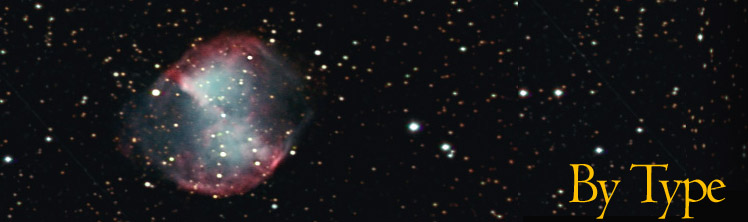
M27The Dumbbell Nebula. |
 |
 |
M57The Ring Nebula |
|
M97 |
 |
 |
NGC 1535 |
|
NGC 2392The Eskimo Nebula |
 |
 |
NGC 7293The Helix Nebula |
|
The Solar System
JupiterThe largest planet in the solar system, Jupiter is a wonderful target. |
 |
 |
MoonThe magnificent desolation of the lunar surface is visible even through a small telescope. |
|
SaturnThe most beautiful planet, Saturn has been visited by the Cassini spacecraft. |
 |
|||


