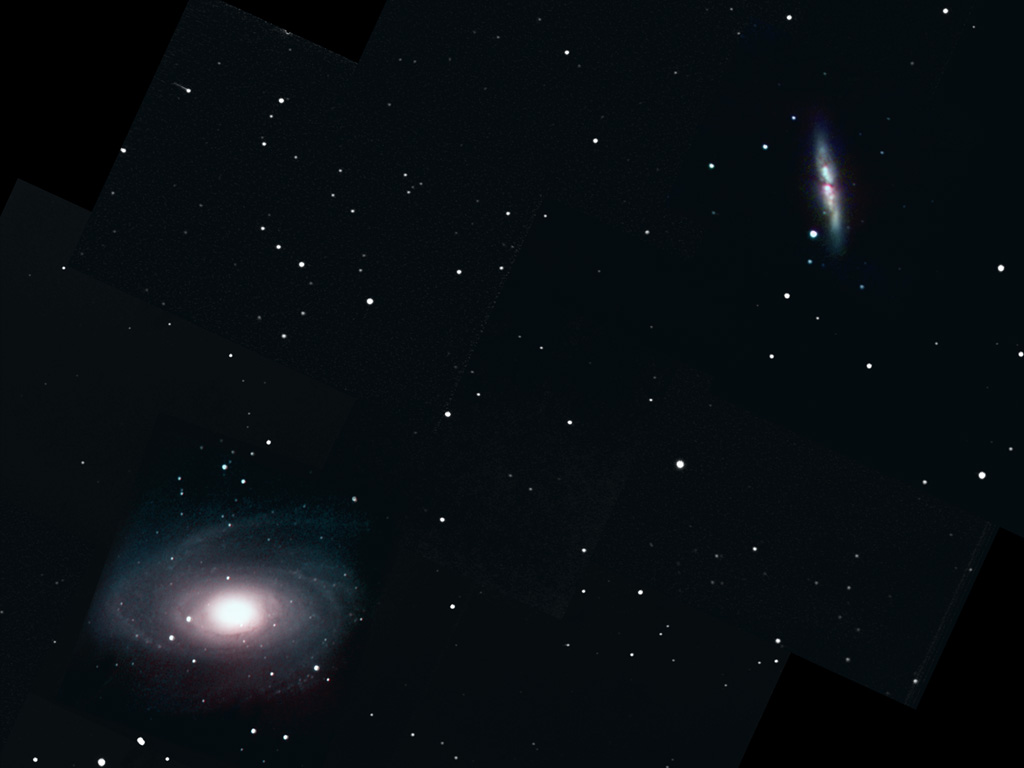
This beautiful pair of galaxies was discovered by professional astronomer Johann Bode in 1774, more than a hundred years after the invention of good quality telescopes. Today, anyone with a modest telescope can easily see the fuzzy patches of light from these two galaxies. So why did it take a hundred years for them to be discovered? As with so many things in life, it's easy to find something if you know where to look. In 1774, before telescope go-to computers, before "Sky Atlas 2000.0" and even before "Astronomy for Dummies," finding a deep sky object was strictly trial and error.
Today, M81 (the large oval galaxy at lower-left) and M82 (the strange galaxy at upper-right) are two of the easiest galaxies to find and photograph.
M81 and M82 are more than 11 million light-years away, and are separated from each other by about 100,000 light-years. There is clearly something wrong with M82. Many astronomers believe that a close encounter with its partner caused M82 to erupt in a frenzy of star formation and destruction.
See also this close up of M81 and close up of M82.
Capturing
I begin all astrophotography sessions by printing out a chart of the region that I'm going to photograph. Next I orient myself by determining how the telescope moves within the chart. For example, if pressing the North button on the telescope moves stars diagonally towards the lower-left, then I know that North on the screen is to the upper-right. This is enough to figure out which way to hold the chart to match the camera output.
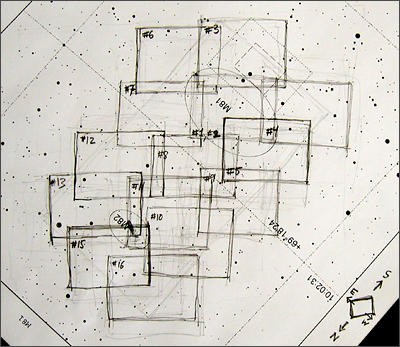
When capturing a mosaic, I use the chart to plot where I've taken each shot. This insures that I capture enough images to cover the whole region and that I provide enough overlap between shots. For example, below is the chart that I used to capture the M81 and M82 widefield image. Each box is one image.